
Peptide research has become one of the fastest-growing areas of biochemical and pharmacological investigation. From metabolic studies to regenerative science, peptides are helping researchers unlock new understanding of cellular signaling, receptor binding, and protein interactions. But there’s a critical factor that determines whether research results are meaningful or misleading: peptide purity.
When browsing suppliers, you’ll often see the claim “99%+ purity research peptides” prominently displayed. This isn’t just marketing language — purity level is one of the single most important variables affecting the reliability, reproducibility, and scientific value of any peptide-based study. In this article, we’ll break down what purity actually means, why it matters so much in laboratory settings, and how researchers can evaluate and select high-purity peptides for their work.
Also read: Research Peptides for Sale: What Laboratories Should Look For
What Does “Peptide Purity” Actually Mean?
Purity refers to the percentage of the actual target peptide present in a sample, relative to any contaminants, byproducts, or residual chemicals left over from the synthesis process.
Peptides are typically manufactured using solid-phase peptide synthesis (SPPS), a stepwise chemical process that builds amino acid chains one residue at a time. While effective, this method can introduce several types of impurities, including:
- Truncated sequences (incomplete amino acid chains)
- Deletion or insertion errors during synthesis
- Residual solvents or coupling reagents
- Aggregated or misfolded peptide structures
- Trifluoroacetic acid (TFA) salts left over from purification
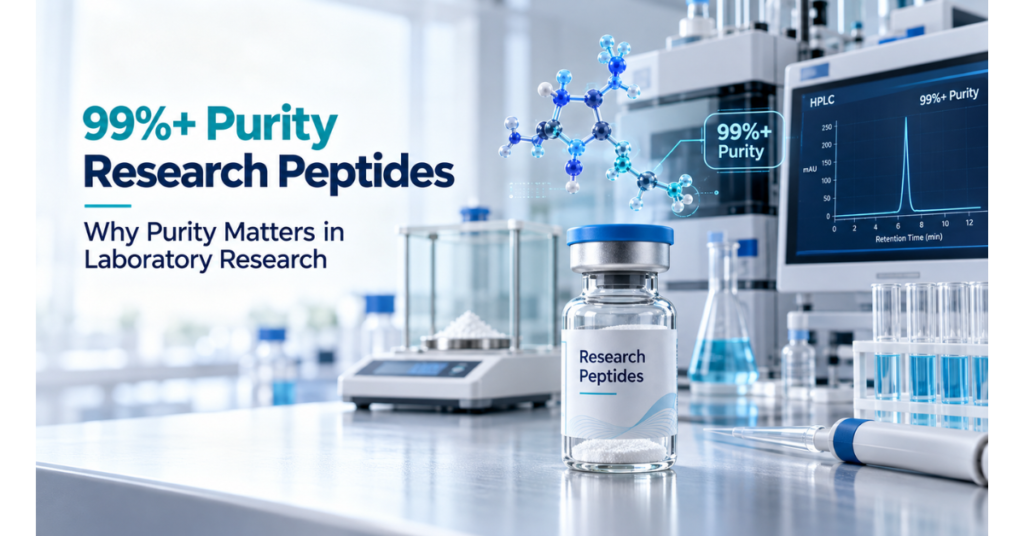
A peptide labeled “99%+ pure” has undergone rigorous purification — usually via high-performance liquid chromatography (HPLC) — to remove these unwanted byproducts, leaving a sample that closely matches its intended molecular structure.
How Purity Is Measured for 99%+ Purity Research Peptides
Reputable suppliers verify purity using two primary analytical methods:
- HPLC (High-Performance Liquid Chromatography) — separates compounds based on their chemical properties, allowing researchers to see a visual “peak” representing the target peptide relative to any impurities.
- Mass Spectrometry (MS) — confirms the molecular weight of the peptide, verifying that the synthesized compound matches the expected sequence.
Together, these tests provide a Certificate of Analysis (CoA), which any legitimate peptide supplier should make available for each batch produced.
Why Purity Matters So Much in Research Settings
1. Reproducibility of Results
Scientific research depends on reproducibility — the ability for other researchers to replicate an experiment and achieve consistent results. If a peptide sample contains variable levels of contaminants from batch to batch, experimental outcomes can shift dramatically, even when the protocol remains identical.
Low-purity peptides introduce a hidden variable into research: are the observed effects due to the peptide itself, or due to impurities present in the sample? This ambiguity undermines the validity of any conclusions drawn from the study.
2. Accurate Dosing and Concentration Calculations
When researchers calculate concentrations for in vitro or in vivo studies, they rely on the assumption that the labeled quantity of peptide reflects the actual active compound in the vial. If a peptide is only 85% pure, for example, actual concentrations will be significantly lower than intended, skewing dose-response data and making it difficult to compare results across studies or laboratories.
99%+ purity minimizes this discrepancy, ensuring that measured and actual concentrations align closely.
3. Reduced Risk of Confounding Variables
Impurities aren’t biologically inert. Leftover synthesis byproducts, aggregated peptides, or residual solvents can trigger unintended reactions in cell cultures or biological assays. This can lead to:
- False-positive or false-negative results
- Unexplained toxicity in cell models
- Altered receptor binding behavior
- Inflammatory responses unrelated to the peptide itself
By using high-purity peptides, researchers reduce the number of confounding variables that could distort experimental data.
4. Structural Integrity and Biological Activity
A peptide’s function is deeply tied to its exact three-dimensional structure and amino acid sequence. Even a single incorrect or missing amino acid can alter how a peptide binds to receptors or interacts with enzymes. Low-purity samples often contain a mix of correctly synthesized peptides alongside truncated or misfolded variants — meaning the “active” fraction of the sample may be much smaller than advertised.
For studies examining receptor binding affinity, enzymatic activity, or signal transduction pathways, this variability can produce misleading data that doesn’t reflect the true biological behavior of the peptide.
The Risks of Using Low-Purity Peptides
Choosing lower-purity or unverified peptides may seem like a cost-saving measure, but it often introduces far greater risks and expenses down the line.
Wasted Time and Resources
Inconsistent results force researchers to repeat experiments, troubleshoot unexplained variability, and second-guess their methodology — all of which consume valuable time, funding, and lab resources.
Compromised Data Integrity
Published research is only as strong as the materials used to produce it. If a study later comes under scrutiny for irreproducible results, tracing the issue back to peptide quality can damage both the credibility of the research and the institution behind it.
Inaccurate Comparisons Across Studies
Research often builds on prior findings. If different laboratories use peptides of varying purity levels, it becomes nearly impossible to draw accurate comparisons or build a cohesive body of scientific knowledge around a given compound.
How to Identify High-Quality, 99%+ Purity Research Peptides
Not all suppliers adhere to the same standards, so due diligence is essential. Here’s what researchers should look for:
Third-Party Certificates of Analysis (CoA)
Legitimate suppliers provide batch-specific CoAs generated through independent lab testing, not just in-house verification. This transparency allows researchers to confirm purity levels, molecular weight, and sequence accuracy before use.
HPLC and Mass Spectrometry Data
Look for suppliers who openly share HPLC chromatograms and mass spec results for each peptide batch. A single clean peak on the HPLC readout is a strong visual indicator of high purity.
Proper Storage and Handling Practices for 99%+ Purity Research Peptides
Even a 99%+ pure peptide can degrade if improperly stored. Reputable suppliers ship products with appropriate cold-chain logistics and provide clear storage guidelines (typically requiring refrigeration or freezing, along with protection from light and moisture).
Transparent Sourcing and Manufacturing Standards
Peptides synthesized in facilities following Good Manufacturing Practice (GMP)-aligned processes tend to exhibit greater batch-to-batch consistency. Ask suppliers about their synthesis methods, quality control procedures, and testing frequency.
Reputation and Peer Feedback
Established suppliers with a track record in the research community are more likely to maintain rigorous quality standards. Look for reviews, citations, or feedback from other laboratories that have used the same products.
Final Considerations for Researchers
Purity isn’t a minor technical detail — it’s the foundation upon which reliable, reproducible, and scientifically valid research is built. Selecting 99%+ purity research peptides helps ensure that experimental results reflect true biological activity rather than artifacts caused by contamination or degradation.
Also read: How to Choose a Reliable Research Peptide Supplier
Conclusion
In laboratory research, precision matters at every stage — and peptide purity is no exception. Contaminants, truncated sequences, and residual synthesis byproducts can silently distort experimental outcomes, leading to wasted resources, irreproducible data, and flawed scientific conclusions. This is why 99%+ purity research peptides are important for maintaining reliable experimental conditions.
By prioritizing 99%+ purity research peptides backed by verifiable HPLC and mass spectrometry data, researchers can trust that their results genuinely reflect the biological properties they’re studying. In a field where reproducibility and accuracy are paramount, investing in 99%+ purity research peptides isn’t just a best practice — it’s a scientific necessity.
Note: Research peptides are intended strictly for laboratory and research purposes only. They are not approved for human consumption, therapeutic use, or diagnostic applications.
Looking for high-quality research peptides? Explore our Shop or Contact Us for product inquiries and assistance.